http://www.pbs.org/wgbh/nova/next/physics/are-black-holes-real/
What is a black hole ?
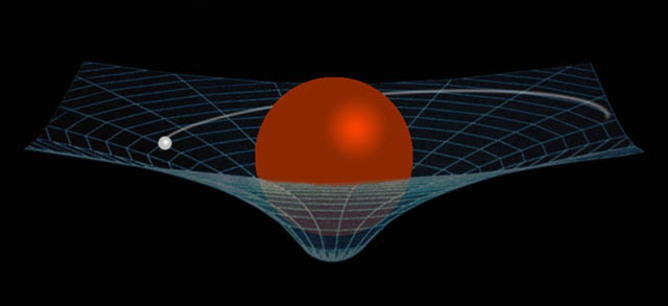
The term “ black hole” was invented by the American physicist John Wheeler in 1967. A black hole is, first and foremost, characterised by the existence of an horizon : it is the spherical surface from which even the light won’t come out, which in that case is inexorably attracted towards a central singularity. The light is affected by the presence of gravity : the stronger the gravitational field is, the weaker the photons which slip from the light and the more displaced they are to a bigger wavelength. Nothing can escape from a black hole and it can be proved by a mathematical application. The equation of the escape velocity ‘v’ is  where G is the gravitational constant and G = 6,67 x10⁻¹¹m3/kg.s², M is the mass of the object and R is the radius. The escape velocity of the Earth is around 11km/s, the escape velocity for a black hole would be superior to the light speed, and we know that nothing can go faster than the light speed.
Only very large stars, called supergiants can become a black hole. The star must be one and a half times the mass of the sun or larger to turn into a black hole. The limit is called the Chandrasekhar limit, so if the star is less heavy than the number it will turn into a smaller type of star but not into a black hole.
Example :
If a friend dives in the black hole, the closer he’s going to be from this one, the slower he is going to fall. When he is going to reach the Schwarzschild radius (the blackhole’s horizon), this movement will take an undefined time. His picture will stay frozen to infinity. His picture will also turn red and then disappear.
However for the person who is coming closer to the black hole, the time is not going to change. but when he looks at your watch, an hour will be accomplished in a second, a millisecond, a microsecond… He will be able to observe the entire future history of the Universe and maybe its end. In a black hole the gravity is stronger and stronger while we go down into it. So the gravity isn’t the same in one black hole. If a friend went in the black hole his feet first, the lower he would get, the more different the gravity would be between his feet and his head, so his body would be quartered (that’s why the name given is “spaghetti effect”). We commonly speak about tidal forces to describe the differences of the gravitational forces with the different distances. The formula of this gravitational attraction is :  and when the distance to center is different, then the force is different and the “spaghetti effect” happens.
Only very large stars, called supergiants can become a black hole. The star must be one and a half times the mass of the sun or larger to turn into a black hole. The limit is called the Chandrasekhar limit, so if the star is less heavy than the number it will turn into a smaller type of star but not into a black hole.
Stephen William Hawking :

http://www.linformaticien.com/actualites/id/33048/stephen-hawking-l-intelligence-artificielle-est-elle-un-loup-pour-l-homme.aspx
He was born on the 8th January in 1942, in Oxford (England). He is a physician theorist, a math teacher at the University of Oxford and a cosmologist. He now works principally to find singularity theorems on the general relativity and to predict theoretically that black holes should produce radiations. His principal domains of research are cosmology and quantum gravity. He wrote “A brief history of time”.
One of the main thing that realized Hawking is that the event horizon of a black hole is not stable, it gets bigger whenever something falls into the black hole. So the event horizon can not get smaller.
“A Brief History of Time: From the Big Bang to Black Holes” was first published in 1988. It was written by Stephen Hawking for ‘normal’ people who are not specialist of scientific theories. Hawking explained the Universe and its development, structure, origin, etc… with non-technical terms. Anyone can read the book and understand Space a lot better because of the easy terms and the simple explanation of the author. The author talks about basic concepts like time and space, basic theories that could be hard for an average person to understand. They are 12 chapters about spacetime, black holes, the Universe… It became a bestseller by selling more that 10 million copies in less than 20 years. It was translated into 35 languages in 2001. A Brief History of Time explains a range of subjects in cosmology to the nonspecialist readers. In total there is only a single equation : E=mc², but the book still employs complex models and diagrams to illustrate the concepts.